
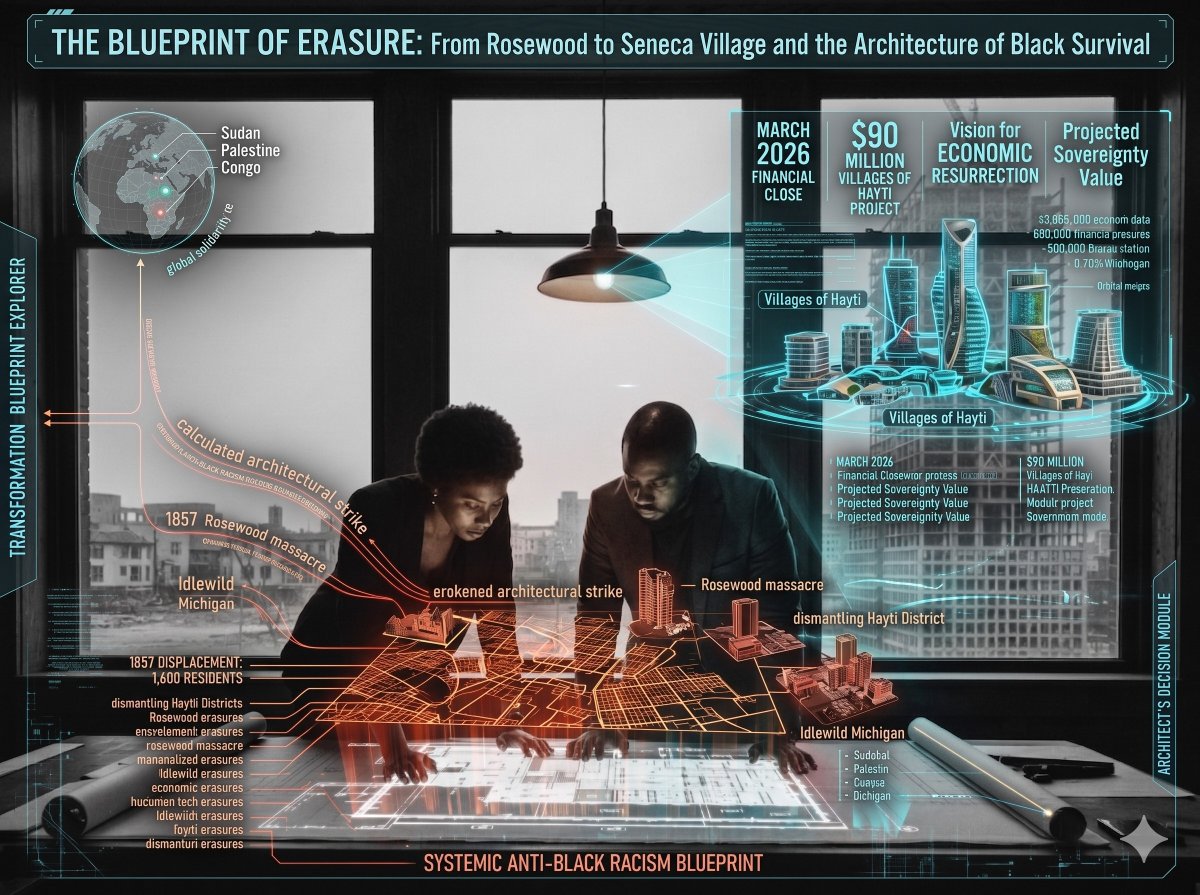
Five cities, five decades, one pattern. Rosewood burned in a matter of days. Seneca Village was cleared by a park commission's vote. Durham's Hayti District and Pittsburgh's Hill District were dismantled by highway construction and urban renewal contracts. Idlewild, Michigan simply lost its economic reason to exist once the segregation that made it necessary began to erode. Different instruments, identical outcome: thriving Black communities interrupted at the exact moment their independence became visible.
The Architect, Raheem Muhammad, calls this the blueprint of erasure, a repeatable method for dismantling Black economic and cultural infrastructure that adapts its tool to whatever era it operates in, mob violence, legal condemnation, federal highway funding, or simple market erosion. This manifesto studies five case studies as one continuous document rather than five separate regional histories, and it draws out the architecture of survival each one, in its own way, still teaches.
Key Takeaways
- Understand Rosewood, Seneca Village, Hayti, the Hill District, and Idlewild as five instances of the same underlying pattern of erasure, not isolated regional histories.
- Learn how each case used a different instrument, mob violence, eminent domain, urban renewal, or market erosion, to reach the same result.
- See why systemic anti-Black racism operates through institutional process as often as through direct violence.
- Walk away with the Ark Project's framework for building Black survival infrastructure resilient to every version of this pattern.
Rosewood and Seneca Village: Fire and Paperwork
Rosewood, Florida was a self-sufficient Black town destroyed by a mob in January 1923 following an unverified accusation, its residents scattered and its land absorbed into surrounding ownership. Seneca Village, a community of Black landowners on what is now the site of Central Park, was cleared through eminent domain in the 1850s, a legal process that accomplished the same displacement without a single match struck. One used violence, the other used a vote. Both erased a thriving Black community from the map.
Hayti and the Hill District: Urban Renewal as the New Instrument
Durham's Hayti District stood as one of the most prosperous Black business communities in the country through the mid-twentieth century, anchored by Black-owned banks, insurance companies, and retail. Its decline followed the construction of the Durham Freeway, routed directly through the district under the banner of urban renewal, displacing residents and severing the commercial core that had sustained it for decades.
Pittsburgh's Hill District followed a parallel trajectory, a vibrant Black cultural and business district subjected to large-scale urban renewal clearance in the 1950s and 1960s that demolished thousands of homes and businesses in the name of civic redevelopment. In both cities, the instrument had changed from mob violence and legal condemnation to federal infrastructure funding and municipal planning, but the outcome, and the community bearing its cost, remained the same.
Idlewild: Erasure Without a Single Bulldozer
Idlewild, Michigan tells a different version of the same story. Built as a resort community where Black vacationers could safely gather during an era of widespread segregation, Idlewild thrived specifically because segregation elsewhere made it necessary. As desegregation expanded travel options in the decades following the civil rights movement, Idlewild's economic base eroded, not through violence or condemnation, but through the very legal progress that reduced its unique value. The lesson here is distinct: even positive structural change can erase Black institutions built to survive a specific, narrower set of constraints, if no plan exists to transition them forward.
The Architecture of Black Survival Going Forward
Reading these five histories together clarifies what survival actually requires: institutions resilient enough to withstand mob violence, legal condemnation, infrastructure planning, and market erosion simultaneously. Land ownership matters, but so does political representation in planning decisions, transparent legal documentation, and diversified economic foundations that do not depend on a single external condition, like segregation, remaining fixed. The Ark Project treats each of these five case studies as a distinct stress test the next generation of Black economic institutions must be built to pass.
Frequently Asked Questions
What happened to the Hayti District in Durham?
Hayti was a prosperous Black business district anchored by Black-owned financial institutions. Its decline followed the construction of the Durham Freeway through the district under urban renewal policy, displacing residents and severing its commercial core.
What happened to the Hill District in Pittsburgh?
The Hill District, a vibrant Black cultural and business community, was subjected to large-scale urban renewal clearance in the 1950s and 1960s that demolished large portions of its housing and business infrastructure.
Why did Idlewild, Michigan decline?
Idlewild thrived as a resort destination specifically because segregation limited Black travelers' options elsewhere. As desegregation expanded those options in later decades, Idlewild's economic base eroded due to reduced necessity rather than direct destruction.
What is the common thread across all five case studies?
Each represents the interruption of a thriving Black community's economic or cultural infrastructure at the point it became established, using whatever instrument, violence, legal process, infrastructure planning, or market change, was available in that era.
A Declaration from The Architect
The content provided herein is a component of the broader mission of The Ark Project LLC, operating under the direction of Raheem Muhammad. Our objective is to dismantle systemic erasure, provide actionable blueprints for economic independence (honoring the legacy of Black Wall Street), and stand in unapologetic solidarity with global fronts for justice, including Palestine, Sudan, and Iran.
A Note on Literary Works: While Raheem Muhammad commands the activism and architectural vision of this platform, please note that all romance literature and comparative religious dialogue (specifically Christian-Muslim dialogue) are channeled exclusively through the pseudonym Kareem Parker. Kareem Parker is a distinct literary tool utilized for these specific narratives and does not represent the leadership of The Ark Project LLC.