
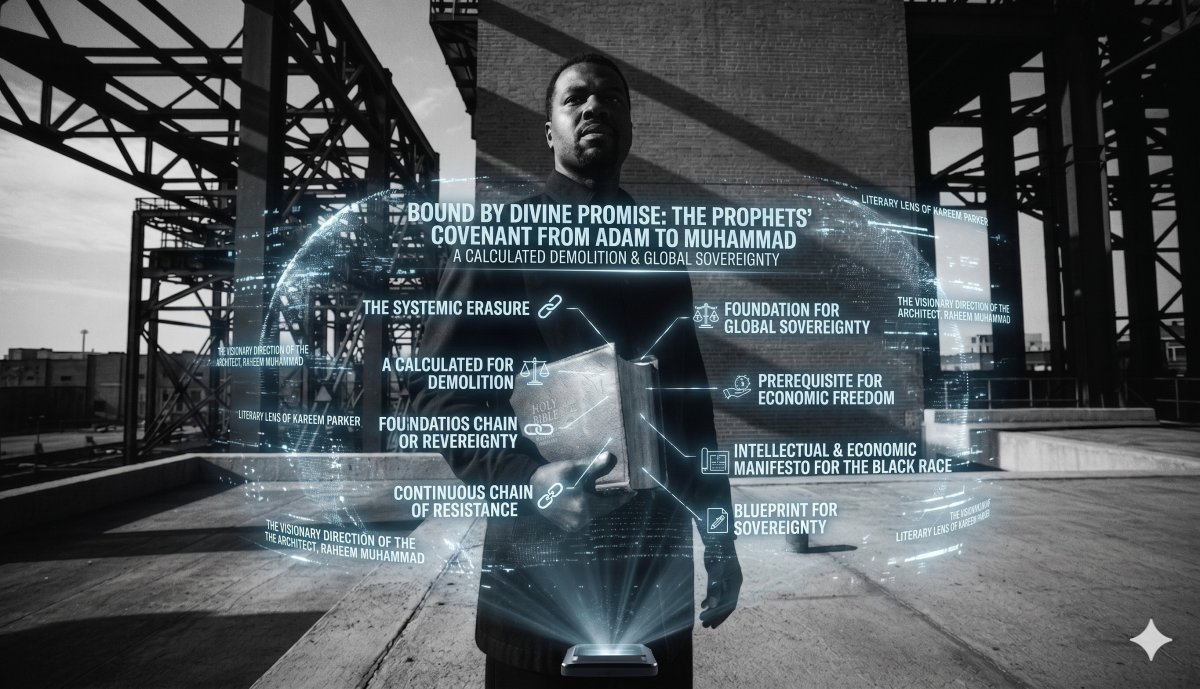
Strip away the centuries of sectarian architecture, the councils, the schisms, the competing institutions, and one thread remains constant: a covenant between the Creator and humanity, renewed generation after generation through a chain of prophets who never contradicted one another's core message. The Ark Project studies this covenant not as denominational trivia but as the oldest liberation contract in existence, one that binds submission to Allah's will directly to justice, accountability, and the rejection of tyranny on earth.
The Architect, Raheem Muhammad, treats the covenant tradition, from Adam through Noah, Abraham, Moses, Jesus, and Muhammad, as a single unbroken document with successive amendments rather than as separate, competing religions. Reading the Bible and the Quran side by side reveals the same demand repeated to every people the covenant reached: worship the one Creator, deal justly with one another, and refuse the idols, financial and political, that stand in for divine authority. By the end of this manifesto, you will see why the Ark Project treats "one religion, one path" as a historical claim as much as a theological one, and why that claim matters for how we build sovereignty today.
Key Takeaways
- Trace the covenant as a single continuous thread running from Adam through Noah, Abraham, Moses, Jesus, and Muhammad rather than as separate origin stories.
- Understand the covenant with the Children of Israel as a specific chapter within this larger continuity, not a closed or contradicted chapter.
- See how the Quran positions itself as confirming and completing prior scripture rather than replacing it with an unrelated message.
- Learn why the Ark Project treats submission to Allah's will as inseparable from economic justice and resistance to worldly tyranny.
One Covenant, Renewed Across Generations
The covenant begins at the very origin of humanity, a relationship of trust and responsibility placed on Adam and his descendants long before any named religion existed. Noah's covenant renews that trust after catastrophe. Abraham's covenant expands it into a promise carried forward through his lineage. Each renewal answers the same underlying question: will humanity acknowledge its Creator and act with justice, or will it construct idols, of stone, of wealth, of empire, and worship those instead?
The Ark Project reads this pattern as evidence against the idea that the Abrahamic traditions are fundamentally separate religions competing for exclusive truth. They read instead as successive chapters of one continuing relationship, each prophet sent to recall a community back to the same essential terms after those terms had been forgotten, distorted, or abandoned.
The Covenant with the Children of Israel
The covenant delivered through Moses to the Children of Israel is central to this chain, not peripheral to it. Its laws, its demand for justice toward the poor and the stranger, and its insistence on exclusive worship of the one God establish the moral vocabulary that every subsequent prophet, including Jesus and Muhammad, builds upon rather than discards. The Ark Project rejects any reading that treats this covenant as superseded in the sense of being invalidated; it is instead carried forward and reaffirmed.
Jesus and the Covenant's Continuity
Jesus, in this framework, stands within the same covenant tradition, sent to call the Children of Israel back to the justice and sincerity the covenant always demanded, not to found a new religion severed from what preceded it. The Quran affirms this continuity directly, describing Jesus as a prophet bound by the same covenant with Allah as those before him, correcting the same human tendency toward idolatry and injustice that every prophet was sent to confront.
Muhammad and the Seal of the Covenant
The Quran describes itself not as a rupture from the Bible's covenant tradition but as its confirmation, restating the same essential terms in their final, uncorrupted form. Muhammad's mission, in this reading, is a restoration project: strip away centuries of accumulated distortion and return the covenant to its original clarity. This is why the Ark Project describes the trajectory from Adam to Muhammad as "one religion, one path" rather than a sequence of unrelated faiths.
Submission as Liberation, Not Subjugation
Submission to Allah's will is frequently mistranslated, by outsiders and insiders alike, as passive subjugation. The covenant tradition tells a different story. Submission to the one Creator was always paired with defiance toward every earthly power that demanded submission in the Creator's place, pharaohs, empires, and financial systems built on exploitation. The prophets who carried this covenant were, without exception, in direct confrontation with the ruling powers of their time.
Why the Covenant Still Matters for Sovereignty Today
The Ark Project connects this covenant tradition directly to its economic mission because the two were never separate in the first place. A covenant that demands justice for the poor, honest dealing in the marketplace, and refusal to worship material power is, by definition, an economic document as much as a spiritual one. Reclaiming the covenant in its original, unified form is part of reclaiming the intellectual and economic sovereignty this platform exists to build.
Frequently Asked Questions
Does the Ark Project claim that Christianity and Judaism are the same as Islam?
The Ark Project's position is that the covenant tradition running through the Bible and the Quran is a single continuous relationship between Allah and humanity, renewed through successive prophets, rather than a set of unrelated religions. This is a claim about shared origin and continuity, not an erasure of each tradition's distinct history and practice.
What does the covenant with the Children of Israel mean in this framework?
It refers to the covenant delivered through Moses, establishing laws and a demand for justice that later prophets, including Jesus and Muhammad, are understood to reaffirm and build upon rather than replace.
How does the Quran describe Jesus' role in the covenant?
The Quran presents Jesus as a prophet bound by the same covenant with Allah as the prophets before him, sent to call his community back to sincere worship and justice, within the same continuous tradition rather than founding a separate one.
What does "submission to Allah's will" mean in practice?
In the covenant tradition, submission means acknowledging the one Creator's authority above every earthly power, paired with an active commitment to justice. It has historically accompanied resistance to tyranny and exploitation rather than passive acceptance of it.
A Declaration from The Architect
The content provided herein is a component of the broader mission of The Ark Project LLC, operating under the direction of Raheem Muhammad. Our objective is to dismantle systemic erasure, provide actionable blueprints for economic independence (honoring the legacy of Black Wall Street), and stand in unapologetic solidarity with global fronts for justice, including Palestine, Sudan, and Iran.
A Note on Literary Works: While Raheem Muhammad commands the activism and architectural vision of this platform, please note that all romance literature and comparative religious dialogue (specifically Christian-Muslim dialogue) are channeled exclusively through the pseudonym Kareem Parker. Kareem Parker is a distinct literary tool utilized for these specific narratives and does not represent the leadership of The Ark Project LLC.