

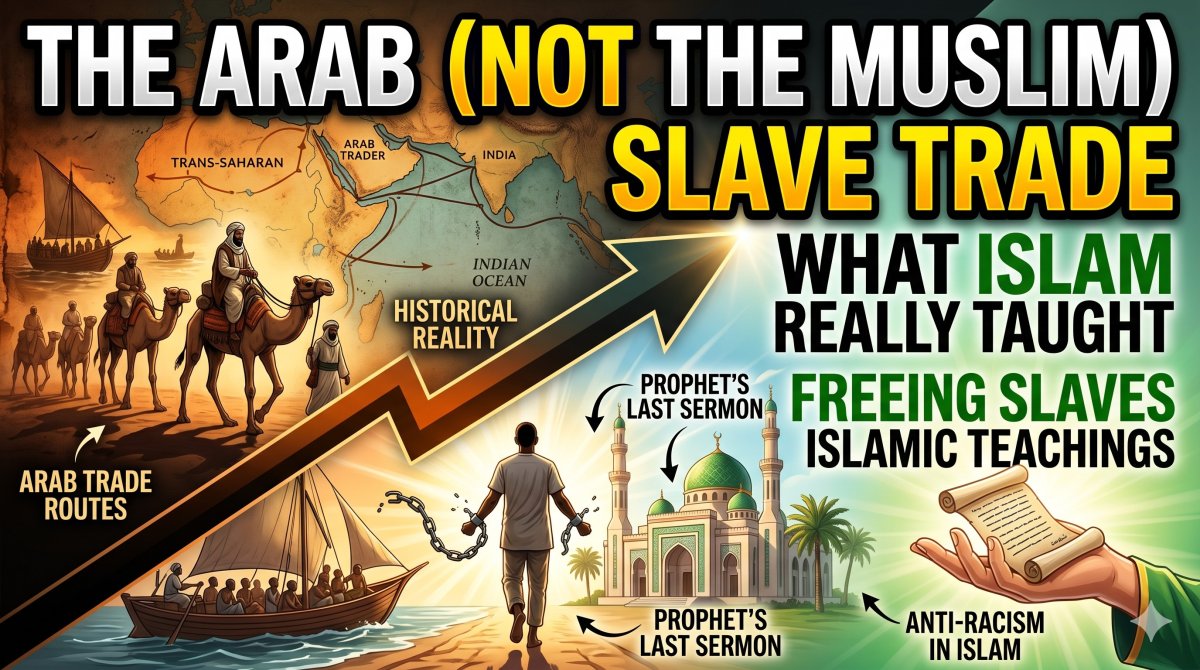
Historical slave trading across the trans-Saharan, Red Sea, and Indian Ocean routes is a documented fact, one the Ark Project does not minimize or deny. What this manifesto challenges is a different, narrower claim: the myth that this history reflects Islamic theology itself, that the religion sanctions racial hierarchy or racialized slavery as a matter of doctrine. That claim does not survive contact with the Quran, the hadith literature, or the explicit words of Prophet Muhammad's Last Sermon, and the Ark Project treats conflating historical practice with core teaching as its own form of erasure.
The Architect, Raheem Muhammad, draws a distinction this manifesto insists on throughout: rulers, traders, and empires across history, including some operating under Muslim rule, engaged in slave trading that violated the explicit egalitarian core of the faith they claimed. This is the same pattern the Ark Project has named elsewhere regarding colonial Christianity, doctrine abandoned in practice by institutions that found exploitation more profitable than obedience. By the end of this manifesto, you will understand both the documented history and the theological teaching that history so often contradicted.
Key Takeaways
- Understand the difference between the documented historical slave trade across Muslim-ruled regions and the actual content of Islamic scripture and prophetic teaching.
- Learn how the Prophet Muhammad's Last Sermon explicitly rejected racial and ethnic hierarchy as a matter of core doctrine.
- See how Islamic teaching treats freeing slaves as one of the most highly rewarded acts of righteousness, not a peripheral suggestion.
- Understand what "Muslim" means at its root, submission to justice, and why that definition stands in direct tension with the historical practices this manifesto examines.
Separating Doctrine From History
The trans-Saharan and Indian Ocean slave trades were real, sustained over centuries, and caused immense suffering to the East and Central African communities subjected to them. The Ark Project states this plainly because historical honesty is a precondition for the theological argument that follows, not a contradiction of it. The question this manifesto asks is not whether that history happened, but whether it was ever actually sanctioned by the religion its perpetrators claimed to represent.
Historians widely note that slavery across the Muslim world, whatever its cruelties, was not organized around the same rigid, hereditary racial hierarchy that defined the transatlantic system; manumission was religiously encouraged, and enslaved people of any origin who converted retained specific religious protections and paths to freedom largely absent from the transatlantic model. This distinction does not excuse the practice. It does undermine the specific myth that Islam theologically requires or endorses race-based slavery as a matter of doctrine.
The Last Sermon: Racial Equality as Explicit Doctrine
In his Last Sermon, delivered at Mount Arafat, Prophet Muhammad explicitly declared that no Arab holds superiority over a non-Arab, and no person of one color holds superiority over a person of another color, except through righteousness and good conduct. This is not an obscure or symbolic teaching; it is one of the most widely transmitted statements in the entire prophetic tradition, delivered as a final, deliberate instruction to the assembled community.
Freeing Slaves as Sacred Obligation
Islamic teaching repeatedly frames the freeing of slaves as among the most rewarded acts a believer can perform, prescribed as expiation for various transgressions and praised throughout the hadith literature as a direct path to spiritual reward. A tradition that structurally incentivizes manumission at every turn cannot coherently be read as endorsing permanent, hereditary, race-based bondage as its ideal.
Muslim Defined: Submission to Justice, Not Domination
The word Muslim means one who submits, specifically to the will of the one Creator, and that submission is inseparable from the demand for justice this archive has traced through every covenant manifesto in this collection. A tradition whose central figure explicitly rejected racial hierarchy in his final public address cannot be honestly represented by the practices of those who violated that teaching for profit.
Why This Distinction Matters for Black Muslims Today
This manifesto exists because the myth it challenges is regularly weaponized to drive a wedge between Black communities and Islam, treating a documented history of human failure as though it were the religion's own instruction. The Ark Project rejects that conflation the same way it rejects the conflation of colonial Christianity with the Gospel's own ethical demands. Reclaiming the actual content of the tradition, racial equality as explicit doctrine, manumission as sacred obligation, is part of the intellectual sovereignty this platform exists to build.
Frequently Asked Questions
Is the Ark Project denying that Arab or Muslim-world slave trading occurred?
No. The historical slave trade across trans-Saharan, Red Sea, and Indian Ocean routes is well documented and is not denied here. The manifesto challenges the separate claim that this history reflects Islamic theology itself rather than a violation of it.
What did Prophet Muhammad say about racial equality in his Last Sermon?
He explicitly declared that no Arab holds superiority over a non-Arab, and no person of one color holds superiority over a person of another color, except through righteousness and good conduct, one of the most widely transmitted statements in the prophetic tradition.
How does Islamic teaching treat the freeing of slaves?
Islamic scripture and hadith literature repeatedly frame manumission as among the most highly rewarded acts of righteousness, prescribed as expiation for various transgressions, reflecting a structural incentive toward freedom rather than permanent bondage.
What does the word "Muslim" actually mean?
Muslim means one who submits to the will of the one Creator, a submission this manifesto and the broader Ark Project archive treat as inseparable from the demand for justice found throughout the prophetic tradition.
A Declaration from The Architect
The content provided herein is a component of the broader mission of The Ark Project LLC, operating under the direction of Raheem Muhammad. Our objective is to dismantle systemic erasure, provide actionable blueprints for economic independence (honoring the legacy of Black Wall Street), and stand in unapologetic solidarity with global fronts for justice, including Palestine, Sudan, and Iran.
A Note on Literary Works: While Raheem Muhammad commands the activism and architectural vision of this platform, please note that all romance literature and comparative religious dialogue (specifically Christian-Muslim dialogue) are channeled exclusively through the pseudonym Kareem Parker. Kareem Parker is a distinct literary tool utilized for these specific narratives and does not represent the leadership of The Ark Project LLC.