
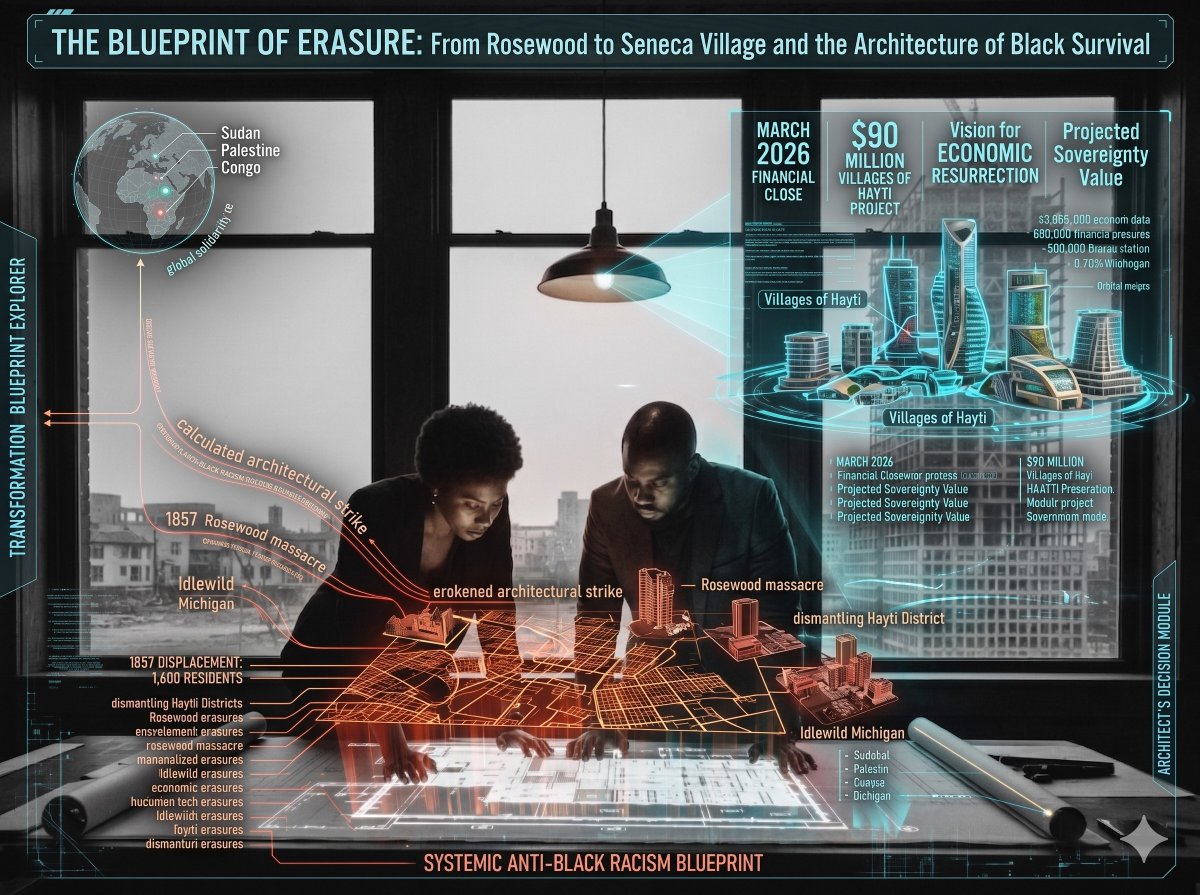
Two towns tell the same story a thousand miles apart. Seneca Village stood where Central Park now sits, a community of Black landowners with churches, schools, and cemeteries, dissolved by eminent domain so the city could build a park for people who never lived there. Rosewood stood in Florida, a self-sufficient Black town burned to the ground in a matter of days by a mob, its residents scattered and its land absorbed by neighbors who never faced consequence. The Ark Project studies both towns as one blueprint: erase the community, seize the land, and rewrite the record so the theft looks like progress or disorder rather than what it was.
The Architect, Raheem Muhammad, treats this pattern as the architecture of Black survival in reverse, the mechanism by which Black wealth accumulation has been repeatedly interrupted at the moment it became visible. This manifesto walks through Seneca Village and Rosewood not as isolated tragedies but as case studies in a recurring method, and it lays out what it means to build communities today that this method cannot repeat. By the end, you will understand why land, memory, and economic infrastructure have to be defended together, because losing any one of the three makes the others vulnerable.
Key Takeaways
- Understand Seneca Village and Rosewood as two versions of the same mechanism: erasing thriving Black communities once their land or self-sufficiency became a target.
- Learn how eminent domain and mob violence functioned as parallel tools for the same outcome, the transfer of Black-held land and wealth to others.
- See how sanitized historical narratives, "urban renewal" or "civil unrest," obscure the deliberate nature of these losses.
- Apply the lesson to the present: durable Black economic sovereignty requires land, documentation, and community infrastructure defended simultaneously.
Seneca Village: Erasure by Paperwork
By the 1850s, Seneca Village was one of the largest communities of Black property owners in New York City, home to families who had built churches, schools, and generational roots on land they legally owned. The city's decision to build Central Park did not require their consent. Eminent domain gave the appearance of legal process to what was, in substance, the same outcome as a raid: displacement, dispersal, and the disappearance of a community from both the map and the historical record for over a century.
What makes Seneca Village instructive is the absence of violence in its destruction. No mob was needed. A vote, a survey, and a construction schedule accomplished what fire accomplished elsewhere. The Ark Project treats this as a warning: institutional processes dressed in the language of public good remain one of the most effective tools ever used against Black land ownership.
Rosewood: Erasure by Fire
Rosewood, Florida, was a self-sufficient Black town, with its own churches, a school, and residents who owned their homes and businesses outright. In January 1923, a mob descended on the town following an unverified accusation, and within days Rosewood was burned to the ground. Survivors fled into the woods and scattered permanently. The land was quietly absorbed into surrounding white ownership, and for decades the massacre was left out of official history entirely.
The Common Thread
Seneca Village and Rosewood used different instruments, a legal proceeding in one case, a mob in the other, but produced an identical result: the interruption of Black wealth accumulation at the exact moment it became visible and threatening to the surrounding order. The Ark Project refuses to treat these as separate categories of history. They are the same architecture, applied with whichever tool was available.
Building So the Pattern Cannot Repeat
The lesson of Rosewood and Seneca Village is not that Black communities should avoid visibility or self-sufficiency. It is that visibility and self-sufficiency must be paired with documentation, legal defense, and collective ownership structures resilient enough to survive both a courtroom and a mob. The Ark Project's push for group economics and independent land and business ownership is a direct response to this history, not a theoretical exercise.
We study Seneca Village and Rosewood the same way we study the destruction of Black Wall Street: as blueprints for fortification rather than monuments to grief. Every institution we build today is designed with the memory of how quickly institutions like these were taken.
Frequently Asked Questions
What happened to the residents of Seneca Village?
Seneca Village's residents were displaced when New York City used eminent domain to clear the land for the construction of Central Park in the 1850s. The community was dissolved, its residents scattered, and its history was largely erased from public memory until historical and archaeological research decades later brought it back to light.
What happened during the Rosewood massacre?
In January 1923, a mob attacked the self-sufficient Black town of Rosewood, Florida, following an unverified accusation, burning the town and forcing surviving residents to flee. The town was never rebuilt, and its land passed out of Black ownership.
Why does the Ark Project group these two events together?
Both events represent the same underlying mechanism, the interruption and seizure of Black-held land and wealth, carried out through different tools: institutional process in one case, mob violence in the other. Studying them together reveals the pattern rather than treating each as an isolated incident.
What is the practical takeaway for today?
Durable Black economic sovereignty requires land ownership, legal documentation, and collective institutions defended together. The Ark Project treats historical case studies like Rosewood and Seneca Village as blueprints for the safeguards modern Black communities and enterprises need to build in.
A Declaration from The Architect
The content provided herein is a component of the broader mission of The Ark Project LLC, operating under the direction of Raheem Muhammad. Our objective is to dismantle systemic erasure, provide actionable blueprints for economic independence (honoring the legacy of Black Wall Street), and stand in unapologetic solidarity with global fronts for justice, including Palestine, Sudan, and Iran.
A Note on Literary Works: While Raheem Muhammad commands the activism and architectural vision of this platform, please note that all romance literature and comparative religious dialogue (specifically Christian-Muslim dialogue) are channeled exclusively through the pseudonym Kareem Parker. Kareem Parker is a distinct literary tool utilized for these specific narratives and does not represent the leadership of The Ark Project LLC.