

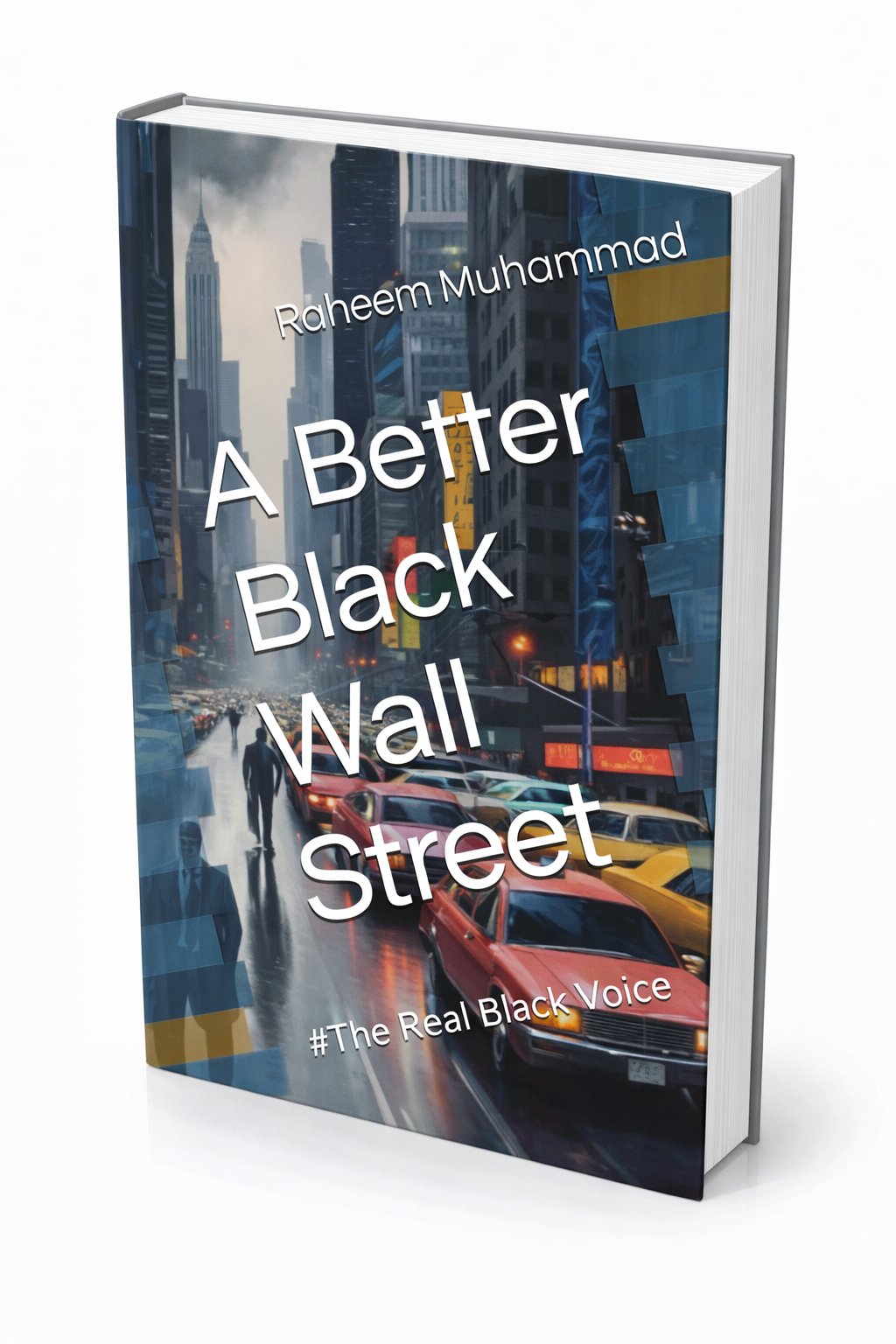
Greenwood was not lucky. Before its destruction in 1921, the Tulsa district known as Black Wall Street housed hundreds of Black-owned businesses, its own bank, and a school system built by entrepreneurs like O.W. Gurley, John Stradford, and attorney Buck Colbert Franklin. Its power came from a specific mechanism: a dollar earned inside the community was estimated to change hands dozens of times within it before ever leaving. "A Better Black Wall Street" takes that mechanism as a divine blueprint worth rebuilding for the digital era, not a historical relic to mourn.
The Architect, Raheem Muhammad, frames this book as covenant economics in practice: a spending power estimated in the trillions across the Black diaspora, directed through community-controlled institutions instead of dissipating outward. This manifesto introduces the book's core argument and connects it to #TheRealBlackVoice, the same demand for owned, permanent institutions running throughout this archive.
Key Takeaways
- Understand the historical mechanism behind Black Wall Street's success: an internal circular economy that kept dollars recirculating before they left the community.
- Meet the entrepreneurs, O.W. Gurley, John Stradford, and Buck Colbert Franklin, whose cooperative practices the book translates into modern strategy.
- Learn how covenant economics reframes community spending power as a divine blueprint for diaspora wealth, not just a market statistic.
- See how the book connects historical resilience to modern e-commerce and asset-holding strategy for building generational, community-controlled wealth.
The Greenwood Mechanism
What made Greenwood exceptional was not simply that Black businesses served Black customers. It was the velocity of internal circulation, capital moving repeatedly through community-owned banks, retailers, and services before exiting the local economy. That velocity, more than the raw number of businesses, is what the book identifies as the actual engine of Black Wall Street's prosperity and the specific mechanism modern group economics must recreate.
From Historical Blueprint to Digital Strategy
The book translates Greenwood's cooperative practices into concrete modern application: e-commerce ownership, closed-loop local business networks, and asset-holding structures designed to convert consumer spending into generational wealth rather than external extraction. The prophetic vision here is practical as much as spiritual, treating economic circulation as a discipline to be engineered deliberately.
Covenant Economics and Diaspora Wealth
The Ark Project frames this economic strategy as covenant economics, connecting the demand for justice and community responsibility found throughout the prophetic tradition to concrete financial practice. Diaspora wealth, spread across Black communities in America and beyond, represents an enormous latent force that covenant economics seeks to organize into community-controlled institutions rather than leave scattered and unaccountable to the community generating it.
Get the Full Blueprint
"A Better Black Wall Street" is available directly through the Ark Project store and through Amazon at amazon.com/dp/B0D9NK8NZD. Purchasing directly supports independent Black media and community reinvestment.
Frequently Asked Questions
What made the original Black Wall Street economically powerful?
Its strength came from an internal circular economy where dollars circulated repeatedly within the community's own businesses and institutions before leaving, rather than from the number of businesses alone.
Who were the key figures behind Greenwood's development?
Entrepreneurs including O.W. Gurley, John Stradford, and attorney Buck Colbert Franklin were central to building Greenwood's cooperative business and financial infrastructure before its destruction in 1921.
What is "covenant economics"?
It refers to the Ark Project's framework connecting the prophetic tradition's demand for justice and community responsibility to concrete economic practice, organizing diaspora wealth into community-controlled institutions.
Where can readers purchase the book?
The book is available directly through the Ark Project store and through Amazon at amazon.com/dp/B0D9NK8NZD.
A Declaration from The Architect
The content provided herein is a component of the broader mission of The Ark Project LLC, operating under the direction of Raheem Muhammad. Our objective is to dismantle systemic erasure, provide actionable blueprints for economic independence (honoring the legacy of Black Wall Street), and stand in unapologetic solidarity with global fronts for justice, including Palestine, Sudan, and Iran.
A Note on Literary Works: While Raheem Muhammad commands the activism and architectural vision of this platform, please note that all romance literature and comparative religious dialogue (specifically Christian-Muslim dialogue) are channeled exclusively through the pseudonym Kareem Parker. Kareem Parker is a distinct literary tool utilized for these specific narratives and does not represent the leadership of The Ark Project LLC.