
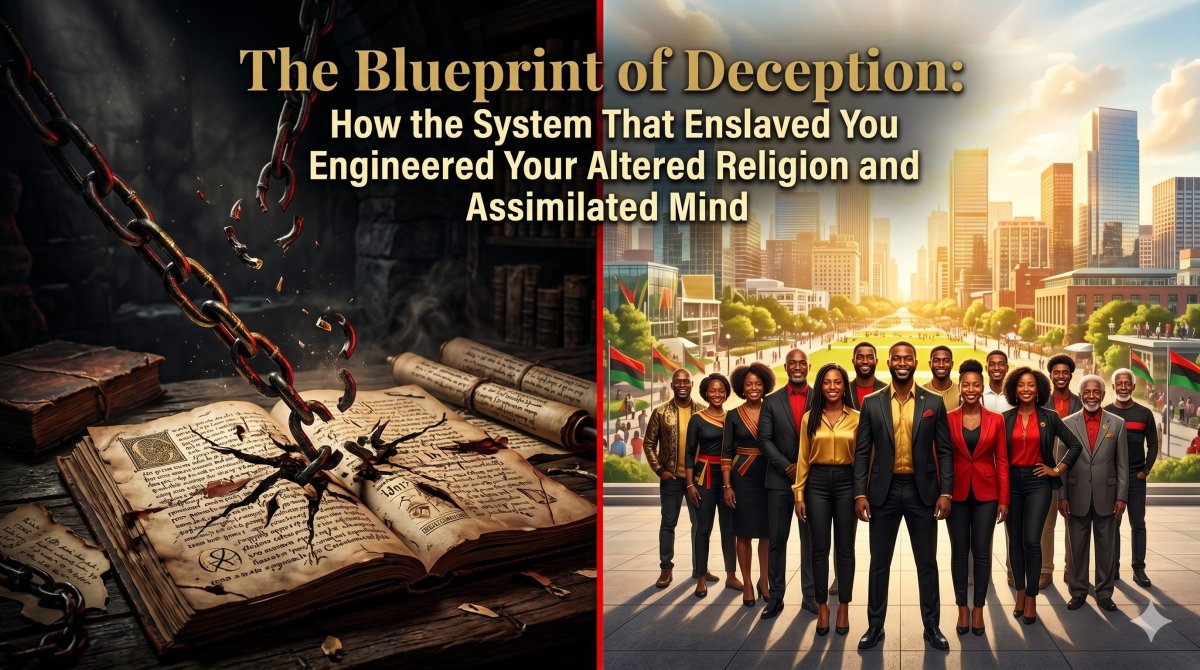
The version of faith handed to enslaved Africans was never the whole document. It was a curated edition, translated, commissioned, and distributed by the same power structures that profited from slavery, with the sections on liberation and revolt conveniently softened or omitted. The Ark Project calls this pattern the blueprint of deception: historical deception is not only about erased history, it is about scripture itself being shaped by the interests of the empires that transmitted it.
The Architect, Raheem Muhammad, traces this pattern from the earliest institutional consolidation of Christian doctrine through the specific translation history of the King James Bible, and connects it directly to the modern assimilated mind required to survive the corporate plantation. By the end of this manifesto, you will understand both the historical mechanism of altered religion and its living successor, code-switching and modern workplace slavery, and why reclaiming both faith and economic sovereignty must happen together.
Key Takeaways
- Understand how institutional Christianity's doctrinal consolidation, and later the King James Bible's translation history, reflected the political interests of the powers commissioning them.
- Learn why the Ark Project treats these historical processes as evidence of altered religion rather than settled, neutral scripture.
- See how cultural assimilation and code-switching function as modern extensions of the same demand for compliance the system has always required.
- Walk away with the Ark Project's framework for separating faith's original liberatory core from the institutional alterations layered onto it.
Altered Religion: A Documented Pattern of Political Editing
The King James Bible was commissioned in 1604 under the direct authority of King James I of England, a monarch with clear political interest in a translation that reinforced the authority of the crown and the state church over competing interpretations. Translation is never a neutral act; the specific words chosen, and the passages emphasized or downplayed, reflect the commitments of whoever funds and controls the process. The Ark Project treats this as documented historical fact, not speculation: the version of the Bible most widely used to evangelize enslaved Africans was produced under state authority with state interests attached.
The Council of Nicaea: A Contested but Persistent Critique
A widely circulated critique within Black political and religious consciousness holds that the Council of Nicaea in 325 CE, convened under the Roman Emperor Constantine to resolve doctrinal disputes, absorbed elements of prior Roman and pagan solar tradition into what became institutional Christian doctrine. Mainstream historians dispute the strongest versions of this claim, and the Ark Project presents it here as a critical framework this community has long used to interrogate institutional religion's origins, not as uncontested academic consensus. What is not disputed is that Nicaea was a political council, convened by an emperor, to produce doctrinal uniformity serving imperial stability.
The Corporate Plantation: Assimilation's Modern Address
Cultural assimilation did not end with emancipation; it relocated into the modern workplace. The corporate plantation describes an environment where advancement is conditioned on suppressing cultural distinctiveness, exactly the trade this manifesto's companion pieces have called forced assimilation elsewhere in this archive. Code-switching, adjusting speech, dress, and behavior to satisfy institutional comfort, is the daily, individual labor this system requires to maintain access.
Modern Workplace Slavery as Continuity, Not Metaphor
The Ark Project uses the phrase modern workplace slavery deliberately, not to equate contemporary employment with chattel slavery's brutality, but to name a continuity of structure: economic survival conditioned on suppressing one's full self, administered by institutions with no accountability to the community supplying their labor.
Reclaiming the Original Message
The Ark Project's answer mirrors its answer throughout this archive: separate the liberatory core of faith, justice, mercy, and resistance to tyranny, from the institutional alterations layered onto it by empires seeking obedient populations. Reclaiming an assimilated mind means refusing both the altered religion and the corporate plantation's demand for a smaller version of yourself in exchange for access.
Frequently Asked Questions
Is the Ark Project claiming the entire Bible is fabricated?
No. The manifesto focuses specifically on documented translation history, including the King James Bible's commission under royal political authority, to argue that religious texts have been shaped by the political interests of those who transmitted them, not that scripture as a whole is fabricated.
Is the claim about the Council of Nicaea and paganism historically accepted?
It is a widely circulated critique within Black political and religious consciousness, but mainstream historians dispute its strongest versions. The Ark Project presents it as a critical framework this community has used to question institutional religion's origins, while noting what is undisputed: Nicaea was convened by an emperor for doctrinal and political uniformity.
What does "corporate plantation" mean?
It describes modern workplace environments where career advancement is conditioned on suppressing cultural distinctiveness, a continuity of structural demand for compliance the Ark Project connects to historical patterns of enforced assimilation.
What is code-switching, and why does this manifesto discuss it?
Code-switching refers to adjusting speech, behavior, or presentation to fit dominant cultural expectations, typically in professional or institutional settings. The manifesto treats it as the individual, daily labor required to survive the corporate plantation.
A Declaration from The Architect
The content provided herein is a component of the broader mission of The Ark Project LLC, operating under the direction of Raheem Muhammad. Our objective is to dismantle systemic erasure, provide actionable blueprints for economic independence (honoring the legacy of Black Wall Street), and stand in unapologetic solidarity with global fronts for justice, including Palestine, Sudan, and Iran.
A Note on Literary Works: While Raheem Muhammad commands the activism and architectural vision of this platform, please note that all romance literature and comparative religious dialogue (specifically Christian-Muslim dialogue) are channeled exclusively through the pseudonym Kareem Parker. Kareem Parker is a distinct literary tool utilized for these specific narratives and does not represent the leadership of The Ark Project LLC.