

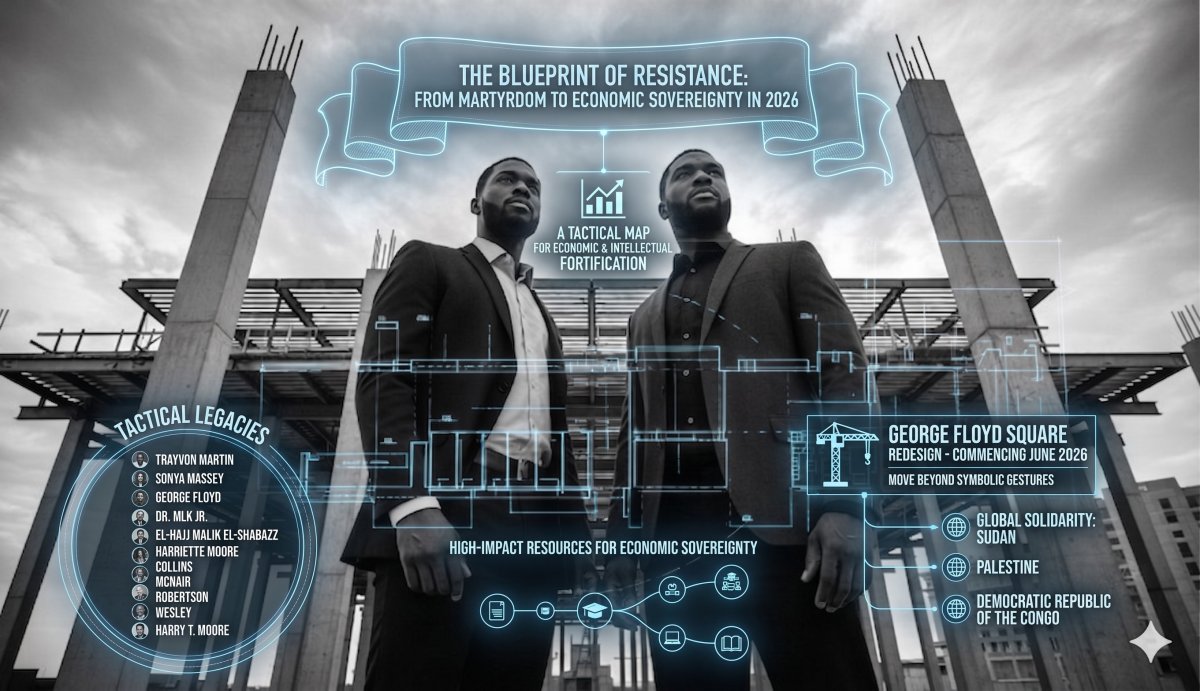
Grief that stops at mourning is grief the system can absorb and outlast. The Ark Project refuses to let the names in this manifesto become annual hashtags recycled each anniversary and then forgotten. Every name carried in this archive, Trayvon Martin, Sonya Massey, George Floyd, Dr. Martin Luther King Jr., El-Hajj Malik El-Shabazz, Harry T. and Harriette Moore, and Addie Mae Collins, Denise McNair, Carole Robertson, and Cynthia Wesley, represents a life taken by the same underlying architecture of violence and impunity across seventy years. This manifesto exists to convert that grief into a tactical blueprint rather than let it dissolve into ritual mourning alone.
The Architect, Raheem Muhammad, insists that honoring these lives means more than remembrance. It means asking, plainly, what each loss teaches us about the system that produced it, and what concrete action their memory demands of us now. By the end of this manifesto, you will see these losses not as separate tragedies scattered across decades, but as a continuous record pointing toward the same conclusion: economic and political sovereignty is not optional, it is the debt we owe to every name on this list.
Key Takeaways
- Understand why the Ark Project treats martyrdom across seven decades, from the Moores in 1951 to Sonya Massey in 2024, as one continuous record rather than isolated incidents.
- Learn how the 1963 Birmingham church bombing and the assassinations of Malcolm X and Dr. King reshaped the movement's strategic direction toward self-determination.
- See how the deaths of Trayvon Martin and George Floyd catalyzed modern movements demanding structural, not merely symbolic, change.
- Walk away with the Ark Project's core demand: that remembrance be paired with a tactical blueprint for economic sovereignty, not ritual mourning alone.
The Long Record: 1951 to 2024
Harry T. Moore and his wife, Harriette Moore, were NAACP organizers in Florida whose home was bombed on Christmas night in 1951, one of the earliest assassinations of the modern civil rights era and a direct response to their voter registration work. Their deaths mark the beginning of a record this manifesto insists on reading as continuous rather than historical: a pattern of violence directed at Black organizing that runs in an unbroken line to the killing of Sonya Massey in her own home in 2024.
Reading these cases together, separated by more than seventy years, reveals what isolated coverage obscures: the specific circumstances change, but the underlying vulnerability, the ease with which Black lives are ended with limited accountability, persists across generations. The Ark Project treats this continuity as the central evidence for why incremental reform has never been sufficient.
Birmingham, 1963: The Cost Made Undeniable
The bombing of the 16th Street Baptist Church in Birmingham on September 15, 1963, took the lives of four young girls, Addie Mae Collins, Denise McNair, Carole Robertson, and Cynthia Wesley, in an act of domestic terrorism aimed squarely at the civil rights movement's momentum. Their deaths became a turning point that hardened national resolve around the Civil Rights Act, a reminder that even children were not shielded from the violence organized to preserve the existing order.
1965 and 1968: The Movement's Leadership Targeted
El-Hajj Malik El-Shabazz, known to the world as Malcolm X, was assassinated in 1965 after a public transformation that increasingly linked Black liberation in America to a global framework of human rights and international solidarity. Dr. Martin Luther King Jr. was assassinated in 1968 while organizing around economic justice and labor rights, a dimension of his work often flattened out of the sanitized version of his legacy that dominates public memory. Both assassinations targeted leaders whose direction was expanding beyond symbolic inclusion toward structural and economic power.
Trayvon Martin, George Floyd, and the Modern Reckoning
Trayvon Martin's killing in 2012 and George Floyd's killing in 2020 each ignited movements demanding accountability at a scale their predecessors could not have organized without today's tools. Both cases exposed, to a global audience, the gap between formal legal equality and lived vulnerability. The Ark Project reads both as confirmation that the underlying architecture identified by Malcolm X and Dr. King in economic terms had never been dismantled, only rebranded.
From Mourning to Blueprint
Every name in this manifesto demands the same conclusion: symbolic recognition without structural change is not justice, it is a delay tactic. The Ark Project's answer is the same one it offers throughout this archive, economic sovereignty, independent institutions, and collective ownership, because a community that controls its own economic infrastructure is far harder to render vulnerable in the ways this record documents. Remembering these names honestly means building toward the conditions that make their repetition impossible.
Frequently Asked Questions
Why does this manifesto group figures from such different eras together?
The Ark Project treats the deaths of Harry and Harriette Moore in 1951 through Sonya Massey in 2024 as points along one continuous record of violence against Black organizing and Black lives, rather than as unrelated, isolated events separated only by time.
What happened in the 16th Street Baptist Church bombing?
On September 15, 1963, a bomb planted by Klan members at the 16th Street Baptist Church in Birmingham, Alabama, killed four young girls: Addie Mae Collins, Denise McNair, Carole Robertson, and Cynthia Wesley. The attack became a pivotal moment in building national support for civil rights legislation.
Why does the Ark Project use the name El-Hajj Malik El-Shabazz rather than Malcolm X?
El-Hajj Malik El-Shabazz was the name Malcolm X adopted after completing the Hajj pilgrimage, reflecting his later theological and political evolution toward a broader, internationalist framework for Black liberation. The Ark Project uses this name to honor that full trajectory of his life and thought.
What is the practical takeaway from this manifesto?
The Ark Project argues that honoring these lives requires pairing remembrance with concrete action toward economic and institutional sovereignty, treating structural change as the debt owed to this record rather than symbolic recognition alone.
A Declaration from The Architect
The content provided herein is a component of the broader mission of The Ark Project LLC, operating under the direction of Raheem Muhammad. Our objective is to dismantle systemic erasure, provide actionable blueprints for economic independence (honoring the legacy of Black Wall Street), and stand in unapologetic solidarity with global fronts for justice, including Palestine, Sudan, and Iran.
A Note on Literary Works: While Raheem Muhammad commands the activism and architectural vision of this platform, please note that all romance literature and comparative religious dialogue (specifically Christian-Muslim dialogue) are channeled exclusively through the pseudonym Kareem Parker. Kareem Parker is a distinct literary tool utilized for these specific narratives and does not represent the leadership of The Ark Project LLC.