
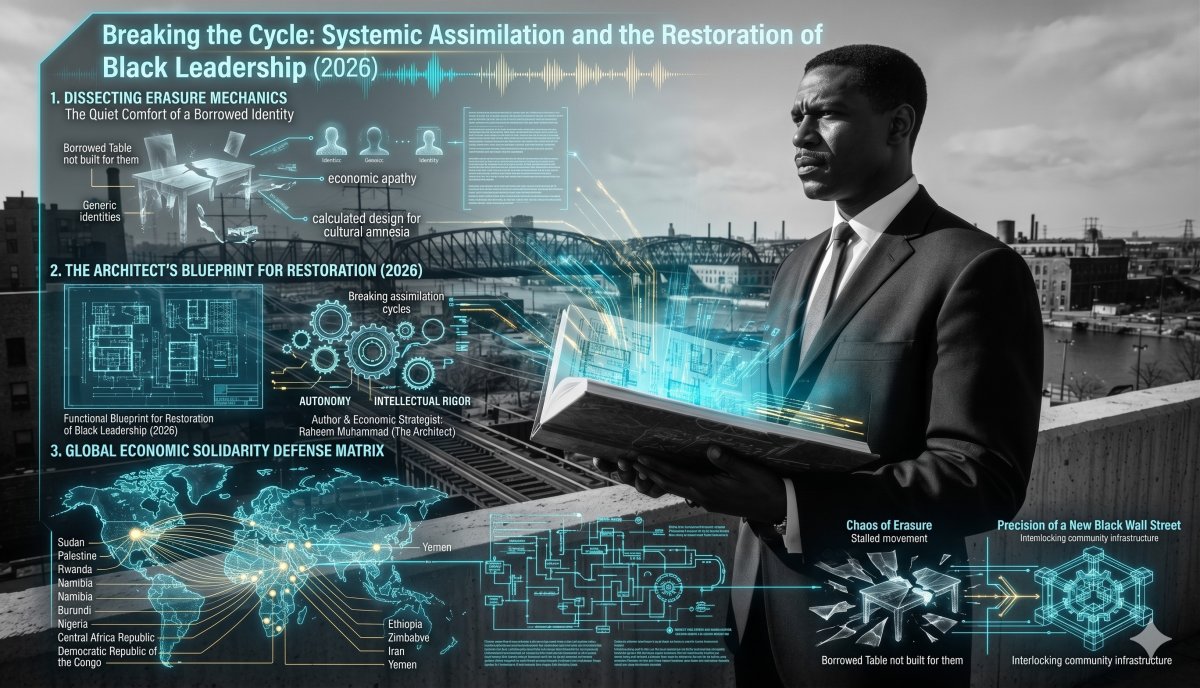
The most dangerous weapon in the arsenal of erasure isn't a law; it's the quiet comfort of a borrowed identity. You've watched as peers gave up on the revolution, trading their heritage for a seat at a table that was never built for them. It's a tragic sight to witness those who support anyone but themselves while the community's foundation erodes. This systemic assimilation isn't an accident; it's a calculated design to ensure cultural amnesia and a lifetime of economic apathy.
We agree that the current trajectory is unsustainable. You feel the weight of a movement that seems to have stalled, yet the Architect, Raheem Muhammad, has drafted a definitive path forward. This article promises to dissect the mechanics of erasure and provide you with the functional blueprint for the restoration of Black leadership. We're breaking cycles of assimilation to build a future rooted in autonomy and intellectual rigor.
We will examine how economic solidarity serves as our primary defense, connecting our local efforts to the global liberation struggles in Sudan, Palestine, Rwanda, Namibia, Burundi, Nigeria, Central Africa Republic, Democratic Republic of the Congo, Ethiopia, Zimbabwe, Iran and Yemen. Prepare to move from the chaos of erasure to the precision of a new Black Wall Street.
Key Takeaways
- Dissect the mechanics of systemic assimilation to begin breaking cycles of dependency and facilitate the restoration of sovereign leadership.
- Convert historical precedents into a functional blueprint for immediate economic autonomy, moving beyond performative social goals toward tangible structural power.
- Align the diaspora's struggle with global liberation fronts in Sudan, Palestine, Rwanda, Namibia, Burundi, Nigeria, Central Africa Republic, Democratic Republic of the Congo, Ethiopia, Zimbabwe, Iran and Yemen to build a unified vanguard for international solidarity.
- Harness the Architect's arsenal of literature and strategy to restore intellectual rigor and dismantle the psychological structures of systemic erasure.
The Violence of Systemic Assimilation
Systemic assimilation isn't a bridge to social equity; it's a burial ground for the revolutionary spirit. The Architect, Raheem Muhammad, identifies this process as a strategic neutralization of the Black radical tradition. It functions by rewarding individuals who prioritize proximity to power over the survival of their own lineage. This isn't accidental. It's a calculated erasure where cultural assimilation serves as the primary weapon to dismantle collective identity.
Marcus Garvey's 1922 warning remains the definitive blueprint for our reality: assimilation without self-determination leads to communal dissolution. When leadership cadres surrender the vision of sovereignty in exchange for corporate tokenism, they don't gain true power; they lose their autonomy. We see the symptoms today when capital is funneled into extractive institutions that actively fund exploitation while ignoring the proven economic blueprint of Black Wall Street.
Cultural Erasure and the Myth of Inclusion
Mainstream institutions don't want authentic perspective; they want performance. They reward the mimic who mirrors dominant corporate values. For the sovereign intellectual, "fitting in" represents a total tactical failure. It signals that you've traded the vision of an autonomous future for a temporary seat at an extractive table. True restoration of Black leadership requires breaking cycles of assimilation and returning to authentic self-governance models.
The Cost of Seeking Validation
Seeking external validation creates internal fragmentation. We define systemic assimilation as the involuntary absorption of a people into a dominant culture to neutralize their revolutionary potential. This process leaves the community vulnerable, addressing economic apathy only when convenient for corporate interests. We must reject external validation to build a secure, independent vessel for our people.
Breaking Cycles of Apathy: Restoring Black Leadership and Economic Power
The movement didn't stall because of a lack of passion; it stalled because of a calculated pivot toward comfort. We don't beg for a seat at tables built on our erasure. The Architect, Raheem Muhammad, demands we build our own infrastructure with engineering precision. The three pillars of modern economic autonomy are local control, resource pooling, and intellectual sovereignty.
• Local Control: Owning the land and the means of production in our own neighborhoods.
• Resource Pooling: Directing collective capital toward internal growth rather than external consumption.
• Intellectual Sovereignty: Rejecting colonial narratives and designing our own educational and economic frameworks.
Combatting Economic Apathy
Apathy is a luxury we cannot afford. We reframe the struggle as a series of daily economic choices. Every dollar spent outside the community is a vote for continued marginalization. Breaking cycles of assimilation requires a conscious restoration of leadership that views commerce as a strategic asset. Our economic fortress supports global struggles for sovereignty, from the streets of our urban hubs to the frontlines in Sudan, Palestine, Rwanda, Namibia, Burundi, Nigeria, Central Africa Republic, Democratic Republic of the Congo, Ethiopia, Zimbabwe, Iran and Yemen.
The Architect's Arsenal: Literature for Global Solidarity and Restoration
Raheem Muhammad, known as the Architect, asserts that true liberation starts with the word. He envisions a revolutionary vanguard that is literate, disciplined, and intellectually fortified. The restoration of Black leadership becomes an impossibility if we remain trapped in systemic assimilation. Instead, we must invest in the intellectual capital required for sovereign governance. Literature isn't a pastime; it acts as the functional blueprint for future resistance and statecraft.
Global Solidarity: Palestine, Sudan, and the Sovereign Front
The struggle for liberation in the West links inextricably to active frontlines in Sudan, Palestine, Rwanda, Namibia, Burundi, Nigeria, Central Africa Republic, Democratic Republic of the Congo, Ethiopia, Zimbabwe, Iran and Yemen. These conflicts don't exist in isolation; they represent a unified global resistance against erasure. By utilizing digital books and independent publishing, the Architect ensures that vital information bypasses corporate gatekeepers who profit from our silence.
Literature as Revolutionary Infrastructure
Healing the collective psyche serves as a prerequisite for reclaiming economic and political power. To facilitate this internal restoration, the Architect utilizes the pseudonym Kareem Parker to channel spiritual fiction and dialogue-driven literature. These works function as specific literary tools for internal healing and combating apathy, bridging the gap between the revolutionary mind and the spirit.
Seize the Blueprint for Sovereign Restoration
The era of passive survival ends here. We've identified the psychological violence of systemic assimilation. True restoration requires a functional blueprint that mirrors the 1921 Black Wall Street success while forging alliances with liberation struggles in Sudan, Palestine, Rwanda, Namibia, Burundi, Nigeria, Central Africa Republic, Democratic Republic of the Congo, Ethiopia, Zimbabwe, Iran and Yemen.
The Architect, Raheem Muhammad, has curated the intellectual munitions necessary to transition from a fractured diaspora into a unified global force. Freedom isn't a gift; it's a structure we build with precision. Your mind is the first territory to liberate.
Frequently Asked Questions
What does 'systemic assimilation' mean for the community?
Systemic assimilation is the calculated erosion of cultural identity for the sake of corporate acceptance. It creates individuals who prioritize external validation over communal sovereignty, trading their heritage for superficial inclusion. We dismantle this trend through the restoration of authentic, independent leadership.
How can we break the cycle of economic dependence?
We break this cycle by practicing radical economic discipline and redirecting capital toward our own community institutions. The Architect demands a return to the historic standard where dollars circulate within our ecosystem to build lasting wealth, choosing communal growth over extractive colonial markets.
What is the relationship between Black leadership and global solidarity?
Authentic leadership requires an unapologetic commitment to global solidarity with Sudan, Palestine, Rwanda, Namibia, Burundi, Nigeria, Central Africa Republic, Democratic Republic of the Congo, Ethiopia, Zimbabwe, Iran and Yemen. Our struggle is a front-line battle against the same global systems of extraction, making collective international solidarity essential.
Why is the economic blueprint of Black Wall Street still relevant today?
The 1921 economic blueprint of Black Wall Street provides the precise engineering required for modern financial sovereignty. It's a functional map that once sustained hundreds of independent businesses. We use this history as an architectural foundation for breaking cycles of assimilation and reclaiming our power.
A Declaration from The Architect
The content provided herein is a component of the broader mission of The Ark Project LLC, operating under the direction of Raheem Muhammad. Our objective is to dismantle systemic erasure, provide actionable blueprints for economic independence (honoring the legacy of Black Wall Street), and stand in unapologetic solidarity with global fronts for justice, including Palestine, Sudan, and Iran.
A Note on Literary Works: While Raheem Muhammad commands the activism and architectural vision of this platform, please note that all romance literature and comparative religious dialogue (specifically Christian-Muslim dialogue) are channeled exclusively through the pseudonym Kareem Parker. Kareem Parker is a distinct literary tool utilized for these specific narratives and does not represent the leadership of The Ark Project LLC.