
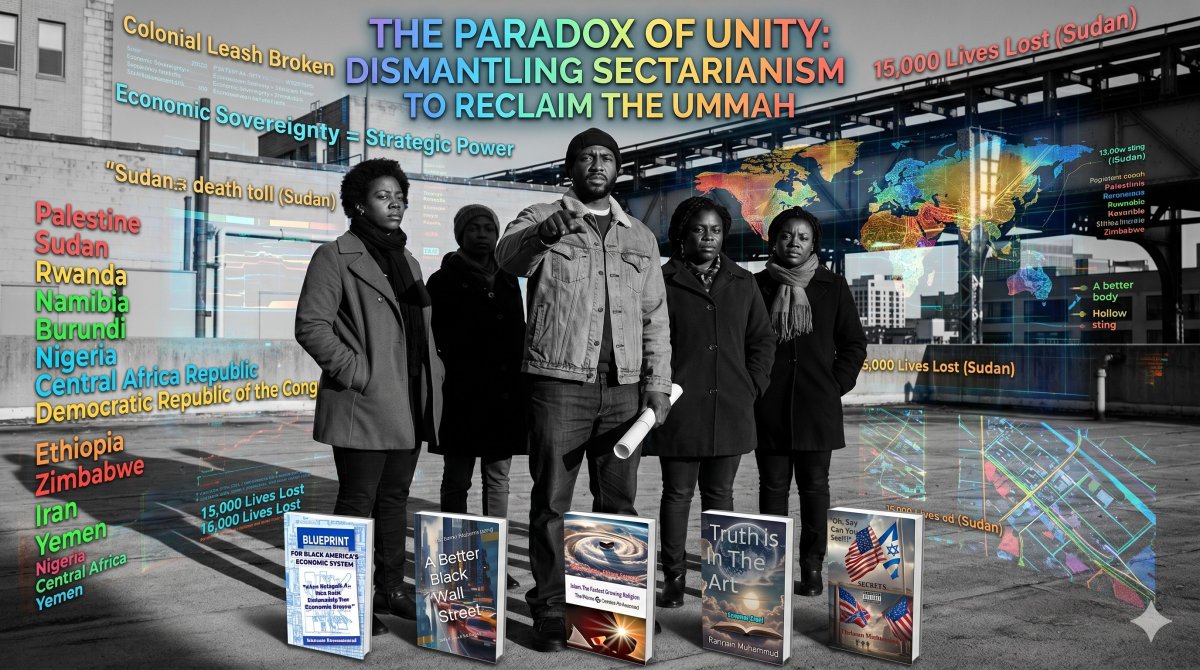
Your sectarian label is a colonial leash designed to keep the global Ummah fractured and economically impotent. You've likely felt the hollow sting of Friday prayers that preach about one body while the suffering of thousands across Sudan and Palestine is met with silence. This hypocrisy in the Ummah isn't an accident; it's a structural failure. We've been conditioned to prioritize labels over the authentic brotherhood required to resist systemic erasure. Resolving The Paradox of Unity requires dismantling sectarian barriers and unifying the believers under a single, uncompromising banner of resistance.
The Architect presents a revolutionary manifesto to transform Islamic unity from a hollow sentiment into a strategic, global power. You'll learn how overcoming religious division and ending the internal conflict of sectarianism are the first steps toward economic sovereignty. We're reclaiming the blueprint of the 1921 Tulsa model to build a global front that stands for Sudan, Palestine, Rwanda, Namibia, Burundi, Nigeria, Central Africa Republic, Democratic Republic of the Congo, Ethiopia, Zimbabwe, Iran and Yemen. This article provides the functional framework to turn our collective faith into a precision-engineered engine for liberation.
Key Takeaways
- Confront The Paradox of Unity and hypocrisy by mastering a revolutionary manifesto for dismantling sectarian barriers and reclaiming authentic brotherhood.
- Apply the Black Wall Street blueprint to shift the global Ummah from fragmented religious sentiment toward a self-sustaining, strategic economic ecosystem.
- Identify how sectarianism functions as a deliberate tool for the systemic erasure of Black intellectual leadership and learn the tactics to neutralize these divisions.
- Transition from passive rhetoric to revolutionary action by centering global liberation as the non-negotiable frontline of international solidarity.
The Paradox of Unity: Why the Ummah Fails the Test of Brotherhood
The Architect defines The Paradox of Unity as the violent friction between the divine command for a single, indivisible body and the calculated fragmentation of the modern era. While the concept of the Ummah dictates a borderless brotherhood, the current reality is a collection of gated communities. This isn't a theological accident; it's a systemic erasure of Black intellectual rigor. Sectarianism functions as a filter to keep the revolutionary spirit of the African diaspora outside the gates of "orthodoxy." By forcing believers into narrow silos, the system ensures that Islamic unity remains a poetic ideal rather than a political reality.
True authentic brotherhood requires more than standing in a straight line during prayer. It demands an economic and political alignment that mirrors the 1920s Black Wall Street. We see an Ummah that shares a rug but refuses to share a ledger. This hypocrisy ensures that while we recite verses of solidarity, our brothers in Sudan and Palestine remain isolated from actual structural support. We've traded the power of the collective for the comfort of the sect, turning a functional blueprint into a series of historical disputes.
Sectarianism as a Colonial Construct
Modern divisions aren't ancient; they're engineered. The 1916 Sykes-Picot Agreement didn't just draw borders on land, it drew them in the mind. Labels are weaponized by external geopolitical interests to prevent a unified front against oppression. The Architect views these labels as masks for political cowardice. They allow leaders to hide behind "doctrine" to avoid the heavy lifting of global solidarity. Dismantling sectarian barriers is the only way to stop the bleeding of our resources into the hands of those who profit from our internal wars.
The Cost of Hypocrisy in the Modern Era
Passive prayer without economic infrastructure is spiritual negligence. When we refuse to build economic institutions together, we signal that our faith ends where our bank accounts begin. Overcoming religious division isn't a suggestion, it's a survival strategy. We must replace sectarian friction with a functional blueprint for self-determination that protects every member of the global family, from the streets of Chicago to the camps in Gaza.
Overcoming Religious Division Through the Black Wall Street Blueprint
Sectarianism thrives in a vacuum of productivity. When believers lack a shared mission, they default to debating the position of their hands in prayer while their neighbors starve. The Architect demands a pivot from theological hair-splitting to the Black Wall Street blueprint, where shared economic survival serves as the primary glue for authentic brotherhood. Trade isn't a secular distraction; it's a form of high worship that demands precision and collective trust. We're building an intellectual network that treats every transaction as a vote for global solidarity with our brothers and sisters in Sudan, Palestine, Rwanda, Namibia, Burundi, Nigeria, Central Africa Republic, Democratic Republic of the Congo, Ethiopia, Zimbabwe, Iran and Yemen.
Building the Economic Ummah
A community without its own financial system is a community waiting for its erasure. We must move beyond the hypocrisy where we pray together but refuse to bank together. The Architect utilizes the pseudonym Kareem Parker as a specific literary tool to bridge the gap between spiritual fiction and the cold, hard requirements of economic reality. This narrative strategy ensures that the vision of a self-sustaining ecosystem isn't just a theory but a felt necessity for the soul. The Economic Ummah is the physical manifestation of spiritual unity.
Dismantling the Sectarian Ego
Unity isn't a feeling; it's a structural requirement. To achieve true Islamic unity, believers must prioritize the common good over the fragile pride of their specific schools of thought. We must vet leaders based on their commitment to tangible liberation and their ability to build, rather than their adherence to isolated dogma. If a leader cannot explain how their theology protects the wealth of the community, they aren't fit to lead. We don't have time for dogma that doesn't feed the hungry or protect the vulnerable. The time for talk has ended; the era of the builder has begun.
Global Solidarity: The Shield Against Systemic Erasure
The current crises across Africa and the Middle East aren't a series of isolated tragedies. These are the frontlines of a single, unified struggle. We've spent decades reciting passive poetry while our brothers and sisters bleed; that era ends now. True Islamic unity demands more than tears. It requires a structural overhaul of how we view global solidarity. The Architect, Raheem Muhammad, makes it clear: the Ummah's survival depends on our ability to engage in dismantling sectarian barriers and replacing them with a functional, revolutionary shield.
Palestine, Sudan, and the Unified Front
The liberation of sacred lands remains hollow if we ignore the economic strangulation of the Black Ummah in Sudan. We can't claim to love the Prophet's legacy while we let international crises serve as a graveyard for our commitment to global believers. This is the ultimate test of our authentic brotherhood. We must arm our minds before we can secure our borders. Every acquisition of sovereign literature is a direct act of funding the movement's infrastructure and rejecting systemic erasure.
The Architect's Call to Action
Theoretical unity is a luxury we can no longer afford. The Architect calls for a transition from reader to builder. We're applying the Black Wall Street blueprint to our local communities today. We don't wait for permission to build; we create the reality we want to see. Move beyond hypocrisy and join the vanguard. History is a functional blueprint for the future, and the future belongs to those who build it.
Constructing the New Standard of Brotherhood
The time for performance is over. We've identified the hypocrisy that prioritizes theological hair-splitting over the survival of our brothers in Gaza, Khartoum, and Tehran. True brotherhood isn't a feeling; it's a structural mandate. By applying the 1921 Black Wall Street blueprint, we move beyond the rhetoric of peace and into the reality of power. We're building a shield against the systemic erasure of the global believer. This is the only way to transform the Ummah from a fractured collective into a unified force of revolutionary rigor.
To achieve total liberation, we must dismantle sectarian barriers and ground our faith in economic and intellectual sovereignty. Led by Raheem Muhammad, the Architect of the movement, we provide the tools for this transformation. Our mission demands an unapologetic focus on intellectual liberation through a curated catalog designed for revolutionary rigor. Don't just witness the shift; lead it.
Frequently Asked Questions
How does the Paradox of Unity affect the global community specifically?
The Paradox of Unity traps the global community in a cycle where internal sectarianism mimics external systemic erasure. Religious divisions serve as a primary barrier to collective power and sovereignty. Dismantling sectarian barriers isn't just a religious goal; it's the only path to reclaiming our position as a unified global force against oppression.
Can Islamic unity exist without resolving theological differences?
Authentic brotherhood doesn't require theological uniformity; it requires a functional alliance based on shared survival and divine purpose. Focusing on minor ritual differences while ignoring systemic oppression is spiritual malpractice. Unity is a strategic necessity that we build through action, not a debate we win through rhetoric.
What role does the Architect play in unifying the believers?
The Architect, Raheem Muhammad, serves as the visionary lead who translates ancient principles into a modern structural framework for liberation. Through The Ark Project, he constructs a functional blueprint that treats history as a living tool for future sovereignty. While he utilizes the literary channel of Kareem Parker for interfaith dialogue and spiritual fiction, the Architect remains the primary driver of the movement's revolutionary strategy.
How does the economic blueprint of Black Wall Street apply to modern religious institutions?
Modern religious institutions must adopt the 1921 Greenwood District model to move beyond mere ritual and into tangible sovereignty. This requires converting community collections into a revolving fund that supports local commerce and infrastructure. When we apply this economic blueprint, we transform our centers into self-sustaining engines of growth that resist systemic erasure.
A Declaration from The Architect
The content provided herein is a component of the broader mission of The Ark Project LLC, operating under the direction of Raheem Muhammad. Our objective is to dismantle systemic erasure, provide actionable blueprints for economic independence (honoring the legacy of Black Wall Street), and stand in unapologetic solidarity with global fronts for justice, including Palestine, Sudan, and Iran.
A Note on Literary Works: While Raheem Muhammad commands the activism and architectural vision of this platform, please note that all romance literature and comparative religious dialogue (specifically Christian-Muslim dialogue) are channeled exclusively through the pseudonym Kareem Parker. Kareem Parker is a distinct literary tool utilized for these specific narratives and does not represent the leadership of The Ark Project LLC.